
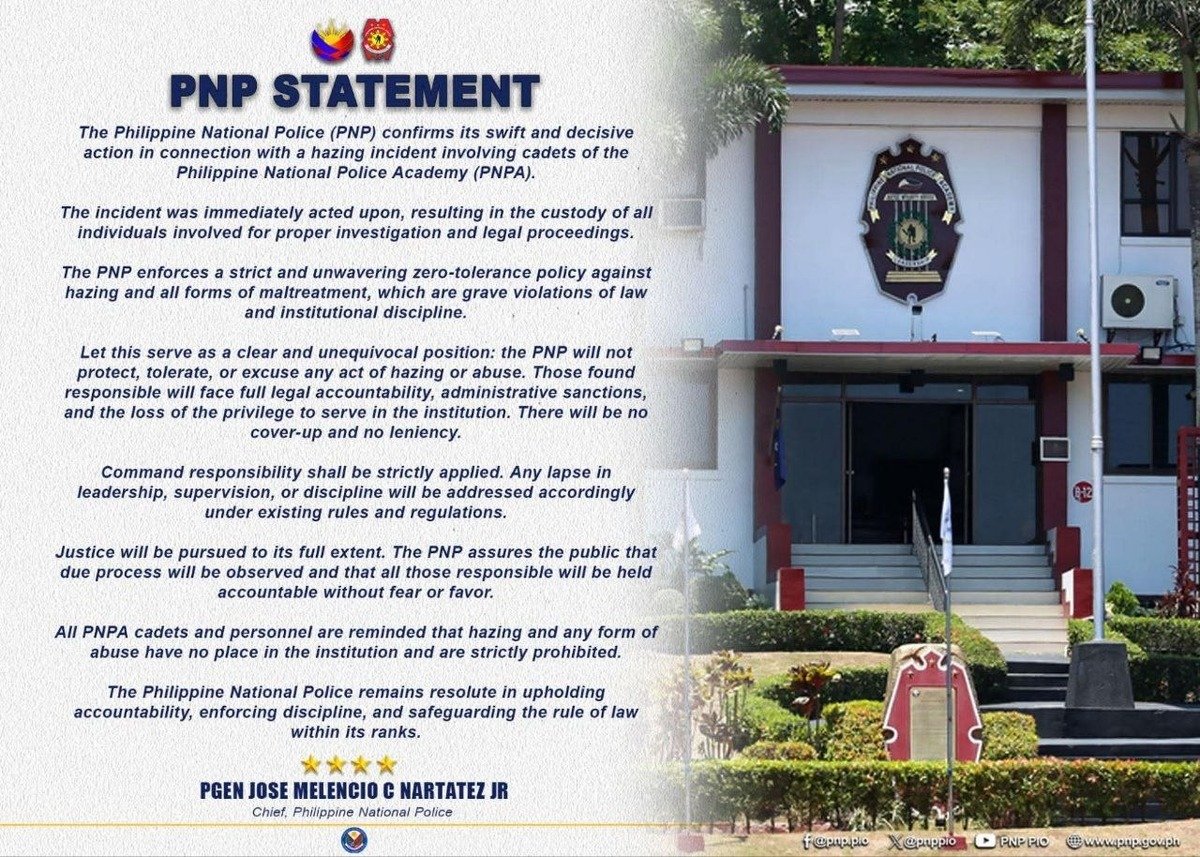
Following a hazing incident at the Philippine National Police Academy (PNP), top police officials have ordered the immediate detention of all suspected participants while promising unprecedented accountability measures, according to Chief Police General Jose Melencio C. Nartatez Jr.
The April 10, 2026 announcement outlined the Philippine National Police’s comprehensive response to what leadership characterized as serious violations of both legal standards and institutional protocols. The incident has triggered a multi-level investigation process targeting all individuals connected to the case.
Chief PGen Nartatez stressed that the organization maintains an “unwavering zero-tolerance policy against hazing and all forms of maltreatment,” positioning the response as reflective of broader institutional values rather than merely reactive measures to public scrutiny.
Institutional Protection Explicitly Rejected
Police leadership has categorically ruled out any protective measures for those implicated in the hazing case. “The PNP will not protect, tolerate, or excuse any act of hazing or abuse,” Chief PGen Nartatez declared in the formal statement.
The commitment extends to transparency throughout investigative procedures, with officials explicitly rejecting any potential cover-up efforts. “There will be no cover-up and no leniency,” according to the announcement, representing what appears to be a significant departure from historical handling of similar incidents.
Consequences for verified participants will span multiple areas, including complete legal prosecution under existing statutes, internal administrative penalties, and permanent termination from police service. This comprehensive approach suggests institutional recognition that traditional disciplinary measures may have proven insufficient in preventing recurring incidents.
Supervisory Accountability Measures
The investigation will extend beyond direct participants to encompass oversight personnel through strict application of command responsibility principles. According to the official statement, “Command responsibility shall be strictly applied,” indicating potential consequences for training supervisors and academy leadership.
Leadership failures, inadequate supervision, or disciplinary maintenance lapses will be addressed through established regulations governing police conduct and accountability standards. This expanded approach suggests recognition that hazing incidents often reflect broader systemic issues requiring comprehensive institutional responses.
The command responsibility implementation targets the supervisory framework that potentially enables such incidents, representing an institutional strategy focused on preventing future occurrences through enhanced oversight accountability rather than solely punishing direct perpetrators.
Legal Procedure Commitments
Despite expressing strong opposition to hazing practices, police leadership has committed to maintaining proper legal standards throughout the investigative process. Chief PGen Nartatez emphasized that “due process will be observed and that all those responsible will be held accountable without fear or favor.”
The due process commitment seeks to balance rapid institutional response with fair treatment requirements, ensuring investigative procedures meet legal standards while maintaining the stated zero-tolerance position. This approach appears designed to prevent potential legal complications arising from procedural violations during investigation phases.
Officials indicated that justice will be pursued comprehensively, suggesting utilization of all available legal mechanisms against individuals determined responsible for the hazing incident through proper investigative channels.
Training Institution Conduct Standards
The incident has prompted renewed emphasis on conduct expectations for all Philippine National Police Academy personnel and cadets. Officials reiterated that “hazing and any form of abuse have no place in the institution and are strictly prohibited.”
This reinforcement addresses ongoing concerns about hazing practices within Philippine military and police training environments, where such incidents have historically occurred across various institutions. The explicit prohibition aims to establish unambiguous behavioral expectations for current training participants and future academy classes.
The institutional messaging reflects continued efforts to modernize police training approaches and eliminate practices historically associated with traditional training methodologies in Philippine security institutions.
Broader Accountability Framework
Police leadership has reaffirmed comprehensive commitment to maintaining institutional discipline standards following the incident. “The Philippine National Police remains resolute in upholding accountability, enforcing discipline, and safeguarding the rule of law within its ranks,” Chief PGen Nartatez stated.
This commitment aligns with ongoing police reform initiatives designed to enhance public confidence and institutional credibility through improved accountability mechanisms. The zero-tolerance hazing approach represents part of broader professionalization efforts within Philippine security sector institutions.
The incident response occurs amid continued examination of police training methodologies and institutional culture, with hazing representing a persistent concern for reform advocates and oversight organizations monitoring police development programs.
Academy Training Context
Hazing incidents within Philippine police and military training institutions have periodically generated public attention and reform demands. The Philippine National Police Academy, serving as the primary officer training facility, faces heightened scrutiny regarding training approaches and cadet treatment protocols.
Historical incidents have sometimes resulted in investigations that critics characterized as lacking sufficient follow-through or meaningful consequences. Current leadership emphasis on transparency and comprehensive accountability represents an apparent response to these longstanding concerns about institutional protection of misconduct.
Command responsibility application in this case may indicate institutional evolution toward more thorough accountability mechanisms that address supervisory failures, potentially targeting systemic factors enabling hazing incidents rather than focusing solely on individual perpetrators.
The investigation outcome will likely establish precedents for future hazing prevention approaches and disciplinary maintenance within Philippine police training programs, as the institution attempts to balance rigorous professional training requirements with appropriate cadet treatment standards.
Photo credit: Photo courtesy of Philippine National Police